
Parameters, not Plans
How Housing Finance Agencies could rethink allocations for better buildings and more units.
Joshua Wilmoth
6/1/20264 min read
The Most Powerful Variable in Affordable Housing Isn't What You Think
The most underappreciated variable in affordable housing development isn't site control, financing complexity, or community opposition. It's who commits first — and how much.
When a Housing Finance Agency (HFA) commits significant resources before the application process has already determined what will get built — before a developer has been forced to lock in every design decision just to compete for a score — something changes in the development process. The developer stops building a case and starts building a building. That shift — from assembly to execution — is where units are won or lost, where efficiency is found or squandered, and where the difference between what a community needed and what it actually got is determined.
I saw this firsthand in Chicago's Brainerd Park neighborhood.
A Deal Reborn
In late 2015, my organization, Full Circle Communities, was approached about stepping into a stalled affordable housing development in the Brainerd Park area of Chicago's south side. The City had selected a developer and a concept in their 2011 LIHTC round, but years had passed, the landscape had shifted, and the deal had gone nowhere. We were asked to come in with fresh eyes.
The parameters were clearly defined from day one. The City of Chicago was committing approximately $12 million in combined resources: donated land, State of Illinois Affordable Housing Tax Credits (Donation Credits), HOME Funds, and a LIHTC allocation. The original proposal had called for 27 townhome units, with a portion reserved for persons experiencing homelessness. Our mandate was to maximize unit count, set aside 25% of units for households experiencing homelessness, and design within building-type and density guidelines shaped by City and community feedback.
Our job, in other words, was not to raise money. The money — the hard money, the first money — was already there.
What that freed us to do was focus entirely on the building itself. Because we weren't constructing a financing argument from scratch, we could direct our energy toward unit mix efficiency, footprint optimization, and supplemental funding opportunities that could move the project further without changing its fundamental structure. We layered in a Federal Home Loan Bank of Chicago Affordable Housing Program (FHLBC AHP) Grant, an Energy Efficiency Grant, and a small permanent loan — each one an attempt to capture additional value within the framework of the primary funding parameters, not a prerequisite for the project to exist.
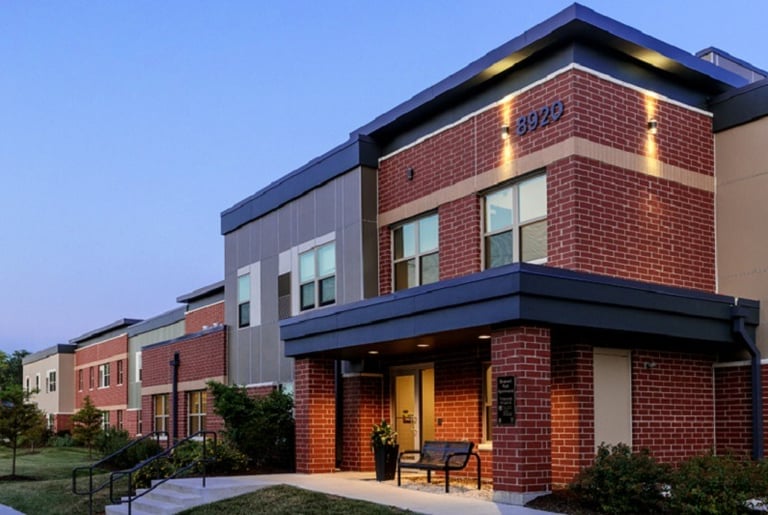
Within twelve months of engagement, we were under construction. In 2018, Brainerd Park Apartments opened: a 36-unit development featuring one-, two-, three-, and four-bedroom units, serving households from 0% to 60% AMI, with nine units assisted by the Chicago Housing Authority. The City had originally envisioned 27 units. We delivered 36 — in a building type the community actually wanted.
That gap wasn't luck. The money came with parameters, not with a predetermined design — and the result was a better building.
What If This Were the Model, Not the Exception?
The typical LIHTC development process works in reverse. A developer identifies a site, spends months — sometimes years — assembling site control, financial projections, community support letters, and scoring documentation, then submits a highly specific application to an HFA. If awarded, they return to finalize what the application already assumed. The deal is designed around the application, not around what the community needs or what the site can actually support.
What might be possible if we flipped that sequence?
Imagine a developer who commits to delivering a minimum number of units and bedroom types, within a defined geographic area, serving a specific population, and meeting established state priorities. Based on that commitment — not a specific building on a specific lot — an HFA allocates LIHTC, soft funds, and rental assistance. The developer then takes that award into the market and designs a project that meets or exceeds the initial goals, with the flexibility to find the right site and the right solution.
Under this model, the developer might maintain options on multiple sites simultaneously, rather than holding a single parcel under contract through a prolonged application cycle. That optionality reduces carrying costs, lowers risk, and preserves the ability to move quickly when the right opportunity presents itself.
The upfront commitment, combined with a clear minimum standard, creates a different kind of incentive. Instead of optimizing for the application score, the developer optimizes for the outcome. Savings discovered during design and construction don't get absorbed — they become additional units, better amenities, or greater long-term efficiency. The developer has every reason to find them.
And perhaps most importantly, this approach asks HFAs to see themselves differently: not as gatekeepers reviewing complete packages, but as catalysts whose early commitment is itself a form of development infrastructure. The largest financial partner in these deals has enormous power to accelerate or constrain the process — not only through regulatory reform, but through the simple act of putting their weight in first.
The Argument
Affordable housing is perpetually resource-constrained. It does not have to be strategy-constrained. The Brainerd Park story suggests that when the major resources are committed and the parameters are clear, developers can do more — not less — than originally imagined.
HFAs have more leverage over development outcomes than they typically exercise. The question worth asking is not just how much to allocate, but when — and whether being the first money in, rather than the last hurdle cleared, might unlock a generation of projects that are faster, more efficient, and more responsive to the communities they serve.
We talk endlessly about resource constraints. Maybe we should talk about sequence.
Joshua Wilmoth is the founder of JCW Consulting, which provides advisory services to nonprofit housing organizations and emerging developers in affordable housing and community development. He previously served as President and CEO of Full Circle Communities, where he grew the organization's portfolio from $35 million to $194 million over eight years.
(Photo courtesy of Full Circle Communities, Inc.)
Organization | Development | Leadership
Email jwilmoth@jcw-llc.com
Call 872-222-8850
© 2025. All rights reserved.